
Your auditor doesn't want logs. Give them proof.
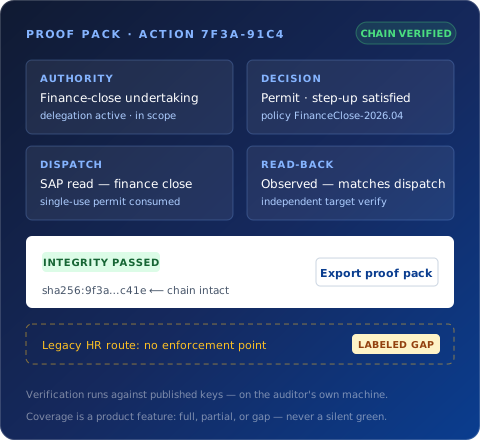
Continuous Evidence turns governed actions into causal, integrity-checked proof — authority, policy decision, dispatch, and observed outcome in one exportable chain, verifiable against published keys without trusting anyone's console. Where coverage ends, the gap is labeled — never painted green.
Signed receipts · append-only change ledger · independent verification · gaps labeled
Enterprises drown in telemetry and still fail audits
Most "audit trails" flatten four different facts into one success string: someone was authenticated, something was permitted — or appeared to be — a call was made, a status code returned. An AI agent can propose, a gateway can return 200, a SIEM can correlate a packet, and still nobody can answer the auditor's actual question:
Under which authority, which policy version, which consumed permit — and with what observed outcome?
2026-04-01 09:14:02  API call success
2026-04-01 09:14:03  User session active
2026-04-01 09:14:05  Model completion tokens 842
An investigator can invent a story from these lines. An auditor can't accept them as proof. Logs help investigate. Causal receipts account for governed actions.
Seven stages. One verifiable chain.
Every governed action on a declared path produces a chain of real control objects — and the chain says what's missing instead of hiding it.
1
Event
Producer, object, time, scope
2
Decision
Policy version, permit or deny
3
Directive
Bound to a consumed permit
4
Job
Transport ≠ business effect
5
Receipt
Signed, hash-linked
6
Verify
Target read-back — or explicit gap
7
Proof
Complete only if integrity passes
SIEM correlation sits alongside the chain, labeled independent — telemetry, never laundered into causation.
Fabric services, not a boxed product
Continuous Evidence is delivered as Identity Fabric services — signing, ledger, timeline, verification, and export — consumed through APIs and operator surfaces. Your portals, applications, GRC tooling, and agents use the same services EmpowerID's own experiences use; nothing here requires adopting a separate product silo.
Signed receipts & custody chain
Every governed action carries a chain of custody — human principal, AI generator, policy authorization, approval, credential vault, executor, downstream identity. Producers sign; consumers verify; the console never grades its own homework.
Config-Change Ledger
Every configuration change and secret access on governed channels becomes an append-only, signed ledger row — who changed what, before → after, under which decision — with drift from out-of-band change surfaced, not silenced.
Evidence Explorer & exports
Operator surfaces built on the same APIs you can call directly: locate by action, actor, object, or ticket; read the causal timeline; toggle explicit gaps; export redacted or full-audit proof packs into your GRC platform, ITSM case, workpapers, or incident file.
Independent verification
Auditors run the verifier against exported records and published keys on their own laptop. Tampering breaks hash chains; truncation fails checkpoint verification. Detectable when verification is run — an honest, testable claim.
Coverage honesty
Six coverage states per path — enforcement, producer, verification, integrity, retention, export. Anything missing is a labeled gap. Break-glass use invalidates enforce-mode claims instead of leaving them quotable.
Published durability model
Which evidence classes are transactional, durable, or best-effort is documented — so control-test evidence sits on durable planes by design, and telemetry is never mistaken for auditor proof.
The story logs never tell: loosen, act, restore
The highest-severity insider incidents aren't exotic. Someone loosens a policy, performs the now-permitted action, and restores the policy. The action chain looks clean; the enabling change disappears into application logs.
The Config-Change Ledger records both halves on the same trust fabric: the configuration change with before-and-after state and its policy decision, and the action it enabled — so the twin record is one export, and an auditor can verify the math.
One export — both halves of the story
- LEDGERED
14:02 · config.change
approval threshold $50k → $500k · actor + decision id recorded
- RECEIPT
14:07 · payment approved
$480,000 · permitted under the loosened threshold
- LEDGERED
14:11 · config.change
threshold restored $500k → $50k · same actor, four minutes later
Without the ledger, only the middle row exists — and it looks perfectly legitimate.
Supports control evidence. Doesn't claim compliance.
DORA, NIS2, SOX, and APRA CPS 230 expect continuous monitoring and audit-ready evidence — not periodic screenshots. Continuous Evidence supplies the evidence for selected control objectives on declared paths, and is explicit about what remains your program: approvals, testing, incident reporting, access reviews, model risk management.
| Control objective | Evidence on declared paths |
|---|---|
| Enforcement before sensitive change | Decision record + deny before dispatch |
| ICT change evidence | Ledger row with before/after + verification |
| Least privilege at runtime | Explained allow/deny with decision identifier |
| Incident reconstruction | Linked proof chain + independent SIEM context |
| AI / agent accountability | Custody chain + delegation + signed receipts |
The Prove stage of the Identity Fabric
Continuous Evidence binds artifacts the fabric already produces — it isn't a logger bolted on afterward. Every governed surface feeds the same evidence rail.
Governed Authorization
Decisions and why-allowed explanations become the chain's Decision stage.
LLM + MCP Gateways
Model and tool enforcement points produce the events, decisions, and receipts the chain binds.
Agent Teams
Team runs, confirmations, and executions land in the same governance timeline and proof packs.
Frequently asked questions
Walk one action from authority to verified export
See a governed action produce its seven-stage chain, export the proof pack, and run independent verification — then see exactly what a gap looks like.
